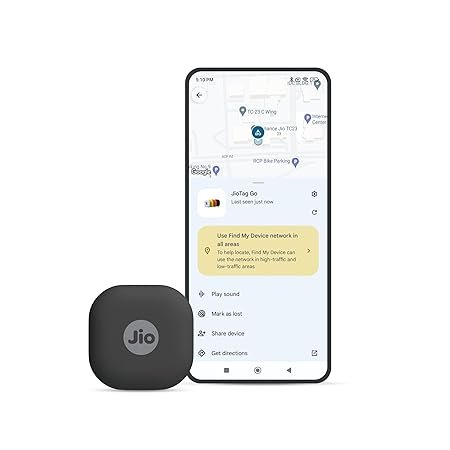
Losing everyday essentials like keys, wallets, backpacks, luggage, or gadgets can quickly become frustrating. Bluetooth trackers have emerged as one of the most practical modern accessories for solving this problem, and the JioTag Go enters the market as an affordable Android-focused smart tracker designed to compete with premium item finders.
Unlike traditional GPS trackers that require SIM cards, subscriptions, and continuous charging, the JioTag Go relies on Google’s Find My Device network to help users locate belongings through millions of Android devices worldwide. This allows the tracker to provide location updates without needing a dedicated mobile connection.
The JioTag Go is particularly important because it fills a major gap in the Android ecosystem. Apple users have long benefited from AirTag tracking through Apple’s Find My network, but Android users previously lacked a similarly integrated tracking solution. Jio aims to solve that issue by offering a compact Bluetooth tracker built specifically for Android devices.
With features like Google Find My Device integration, 120dB buzzer, replaceable battery, worldwide tracking support, and lightweight design, the JioTag Go positions itself as an affordable smart tracking gadget for everyday users.
JioTag Go Specifications
| Feature | Details |
|---|---|
| Product Type | Bluetooth Smart Tracker |
| Network Support | Google Find My Device |
| Compatibility | Android 9 and above |
| Connectivity | Bluetooth |
| Alarm Sound | 120dB buzzer |
| Battery Life | Up to 1 year |
| Battery Type | CR2032 replaceable |
| SIM Requirement | No |
| Weight | Around 9g |
| Tracking Range | Global tracking via Android network |
The specifications show that Jio is focusing heavily on simplicity, portability, and ecosystem integration rather than traditional GPS-based live tracking.
Design and Build Quality
One of the strongest aspects of the JioTag Go is its compact and lightweight design.
The tracker adopts a coin-sized form factor that can easily attach to:
- Keys
- Wallets
- Bags
- Luggage
- Cameras
- Bicycles
- Pet accessories
- Documents
Its lightweight 9g construction ensures it does not add unnecessary bulk to personal belongings. The small footprint also improves concealment when placed inside bags or hidden compartments.
The plastic shell feels reasonably durable for normal daily usage, while the integrated loop design simplifies attachment to keychains and accessories.
Jio offers the tracker in multiple color variants, adding a bit of personalization to an otherwise utility-focused gadget.
The overall design prioritizes convenience and portability over luxury aesthetics, which makes sense for a practical tracking accessory.
Setup and Google Find My Device Integration
The biggest advantage of the JioTag Go is its integration with Google’s Find My Device network.
The setup process is relatively simple:
- Install Google Find My Device
- Turn on Bluetooth and Location
- Power on the JioTag Go
- Pair the tracker using Fast Pair
Once connected, the tracker becomes part of Google’s massive Android device network.
This means nearby Android devices can anonymously help update the tracker’s location even when it is outside Bluetooth range.
The integration significantly improves the practicality of Android-based item tracking compared to older standalone Bluetooth trackers.
Tracking Performance
The real-world tracking experience depends heavily on nearby Android device density.
Nearby Tracking
Within Bluetooth range, users can:
- Ring the tracker
- Trigger sound alerts
- Locate misplaced items quickly
The 120dB buzzer is surprisingly loud for such a small device and works effectively indoors.
For misplaced keys, bags, or wallets inside homes and offices, the JioTag Go performs reliably.
Long-Distance Tracking
Outside Bluetooth range, the tracker relies on Android devices nearby to update its location.
In urban environments with dense Android usage, tracking accuracy becomes significantly better.
However, users should understand that this is not true real-time GPS tracking.
Location updates may vary depending on:
- Nearby Android device availability
- Population density
- Google Find My Device network activity
- Environmental conditions
Rural or low-traffic areas may result in slower updates.
Performance and User Experience
The day-to-day experience with the JioTag Go feels straightforward and beginner-friendly.
The Google Find My Device interface remains simple enough for most users to understand quickly.
Users can:
- View last known location
- Play sound alerts
- Enable lost mode
- Get navigation directions
- Rename trackers
The Fast Pair functionality also simplifies onboarding compared to many older Bluetooth trackers.
One practical advantage is that no SIM card or subscription plan is required.
This makes the long-term ownership cost significantly lower than dedicated GPS trackers.
Battery Life
Battery performance is one of the strongest aspects of the JioTag Go.
The tracker uses a replaceable CR2032 battery capable of lasting up to one year under normal usage conditions.
Jio even includes an extra battery in the package, which improves value for money.
Unlike rechargeable trackers that require frequent charging, the JioTag Go focuses on low-maintenance operation.
The replaceable battery design also extends the product’s usable lifespan significantly.
Everyday Use Cases
The JioTag Go works particularly well for users who frequently misplace essential items.
Keys and Wallets
This remains the most practical use case. The loud buzzer makes nearby retrieval extremely easy.
Luggage Tracking
Travelers can track luggage during airport transfers and hotel stays.
Backpack and Laptop Bags
Students and professionals can monitor bags during commuting or travel.
Vehicle Tracking
While some users place the tracker inside vehicles, it should not be considered a dedicated anti-theft GPS solution because it depends on nearby Android devices rather than live cellular tracking.
Pet Tracking
The tracker can serve as a basic backup tracker for pets, but it is not suitable as a primary live pet-tracking device.
Comparison With Similar Trackers
| Attribute | JioTag Go | JioTag Air | MiTag Go | Qubo Wireless GPS Tracker |
|---|---|---|---|---|
| Platform | Android | iOS | Android | GPS-based |
| Network Support | Google Find My Device | Apple Find My | Google Find My | Cellular GPS |
| SIM Required | No | No | No | Yes |
| Battery Life | Up to 1 year | Up to 1 year | Up to 1 year | Shorter |
| Real-Time Tracking | Semi real-time | Semi real-time | Semi real-time | Yes |
| Global Coverage | Yes | Yes | Yes | Depends on network |
| Best Use Case | Everyday item finding | Apple ecosystem users | Android users | Vehicle tracking |
| Size | Ultra compact | Compact | Compact | Larger |
Pros and Cons
Pros
- Affordable Android tracker
- Google Find My Device support
- Lightweight and compact design
- Loud 120dB buzzer
- No SIM card required
- Up to 1-year battery life
- Replaceable battery
- Easy setup process
- Global Android network compatibility
- Useful for keys, wallets, and bags
Cons
- Not true real-time GPS tracking
- Depends on nearby Android devices
- Accuracy may vary in remote areas
- No iPhone compatibility
- Tracking delays possible in low-density areas
Buying Considerations
Before purchasing the JioTag Go, users should clearly understand what type of tracker it is.
Buy This Tracker If:
- You use an Android smartphone
- You frequently misplace items
- You want affordable smart tracking
- You need luggage or key tracking
- You prefer long battery life without subscriptions
Avoid It If:
- You need precise live GPS tracking
- You want dedicated anti-theft tracking
- You use an iPhone
- You require instant real-time location updates
Community Feedback and Real-World Experience
Community discussions surrounding the JioTag Go remain largely positive regarding affordability and ecosystem integration.
Many users have reported strong performance in populated regions where Android device density is high. Others highlighted that Google’s Find My Device network has improved significantly over time in countries with strong Android adoption.
However, users also noted limitations involving delayed location refreshes and reduced effectiveness in isolated areas.
These observations are important because Bluetooth trackers naturally behave differently from full GPS trackers.
Verdict
The JioTag Go successfully brings affordable Android-compatible item tracking to mainstream users. By leveraging Google’s Find My Device ecosystem, Jio has created a practical alternative for Android users who previously lacked a seamless smart tracking solution.
Its compact size, loud buzzer, replaceable battery, lightweight design, and Google integration make it highly useful for tracking everyday belongings like wallets, keys, backpacks, and luggage.
The tracker works best in urban environments with strong Android device density, where location updates become more frequent and reliable.
While it cannot replace dedicated GPS trackers for live vehicle or personal safety monitoring, it performs very well for its intended purpose: helping users recover misplaced belongings efficiently.
For Android users searching for an affordable Bluetooth tracker with long battery life, Google Find My Device support, and practical everyday utility, the JioTag Go stands out as one of the most accessible and useful smart tracking gadgets currently available.
If you enjoyed this article, don’t miss our previous posts packed with tech insights and reviews—check them out on our website!


