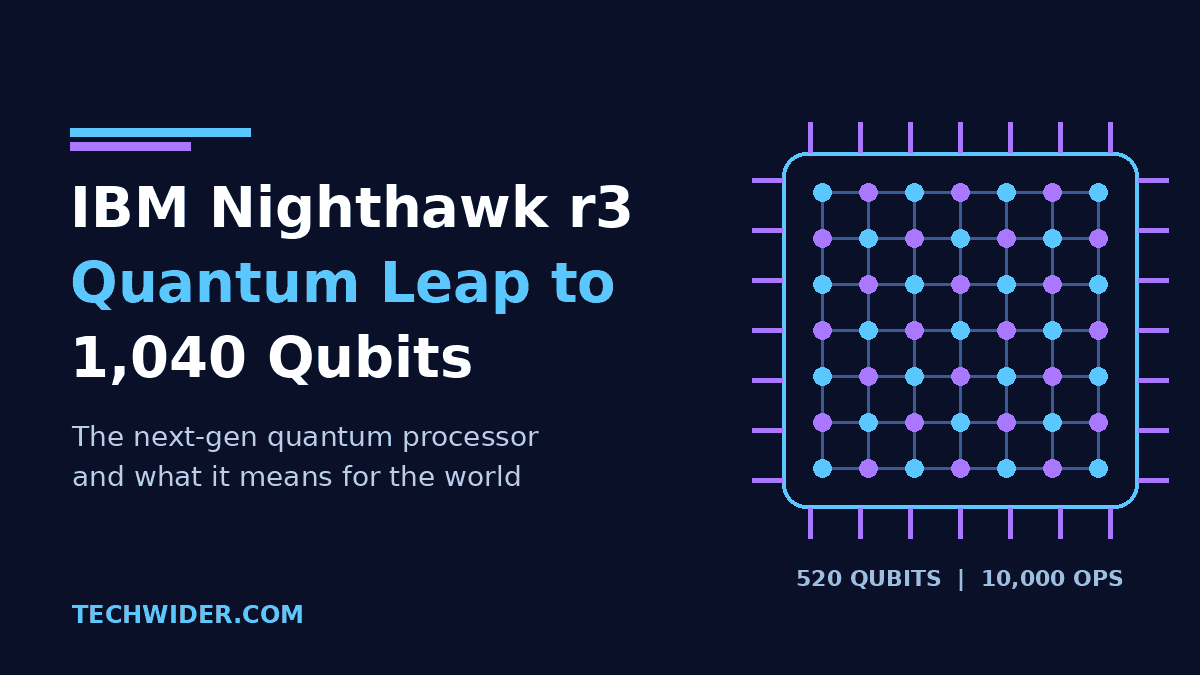
Quantum computing has spent years living in the future tense — always “five to ten years away.” This month, that timeline got noticeably shorter. At its annual Quantum Developer Conference in Yorktown Heights, New York, IBM Quantum unveiled Nighthawk r3, a next-generation processor designed to accurately run 10,000 quantum operations across 520 programmable qubits. Even bigger, IBM says it will link two of these chips into a single 1,040-qubit system in 2027.
For businesses, researchers and governments around the world racing to make quantum computing useful, this is one of the most important hardware announcements of 2026. Here is what IBM revealed, how it works, and why it matters.
IBM Nighthawk r3 at a Glance
- Programmable qubits: 520 (out of 2,034 physical qubits on the chip)
- Operation budget: 10,000 accurate two-qubit operations per circuit
- Architecture: square-lattice connectivity carried over from Nighthawk r2
- Chip-to-chip links: 10 “l-couplers” for joining processors together
- Roadmap: two linked r3 chips forming a 1,040-qubit system in 2027
- Availability: planned for 2027; not yet available to customers
Compared with the current Nighthawk r2, which offers 120 programmable qubits and more than 7,500 operations, r3 brings about 4.3 times the programmable qubit count and roughly a third more operations per circuit.
Why “10,000 Operations” Is the Number That Matters
Headlines about quantum computers usually focus on qubit counts, but raw qubits alone don’t make a machine useful. What really counts is how many reliable operations — called gates — a processor can perform before errors pile up and the result becomes noise. That figure determines how deep and complex a quantum program can be.
IBM’s message is that scale, quality and speed must improve together. As Jay Gambetta, Director of IBM Research, put it, useful quantum computing depends on delivering results with both accuracy and speed. Speed matters because a quantum computer doesn’t give a single answer; it produces samples. Complex problems can require millions or even billions of circuit runs, so a faster chip directly translates into getting useful answers in hours instead of weeks.
The Secret Ingredient: Modular Chips
The most interesting part of Nighthawk r3 isn’t the chip itself — it’s how it connects to other chips. Each r3 includes ten l-couplers, IBM’s name for links that let separate processors share quantum information and behave like one larger machine.
This modular approach solves a fundamental engineering problem. Building one gigantic quantum chip is extremely difficult because defects and errors grow with size. Linking smaller, high-quality chips together is far more practical — much like how modern data centres scale by connecting many servers instead of building one enormous computer.
IBM has already shown early progress here. Using four l-couplers on an earlier Nighthawk generation, it achieved 99.3% quantum state transfer fidelity between processors, with a target of 99.9%. It also connected two cryogenic modules into one system, cooling them below 15 millikelvin — colder than outer space — in under five days.
Real Results From Nighthawk r2
IBM backed its roadmap with numbers from Nighthawk r2, which launched in September 2026 and is available today. The processor can deliver up to 100,000 samples per second, and clients and partners have already run around 34 billion circuits on it. Highlights include:
- Energy (Germany): E.ON reported a 15x speedup in quantum machine learning for power grid optimisation.
- Materials science (USA): IBM and Oak Ridge National Laboratory saw a 12x speedup when simulating real magnetic materials, with results matching neutron scattering experiments.
- Quantum chemistry (Finland): Algorithmiq’s material simulation now runs 8x faster than on IBM’s older Heron processor.
- Healthcare (USA/Japan): Cleveland Clinic and Japan’s RIKEN processed 608 million samples for modelling biological structures, 33x faster with workflow automation.
Overall, partners report speedups of up to 19x compared with IBM’s previous quantum processors. The global spread of these partners — across Europe, North America and Asia — shows how quantum research has become a truly international effort.
Quantum + Supercomputers: The Hybrid Strategy
IBM is not pitching quantum computers as replacements for classical machines. Instead, its strategy is hybrid: run on classical computers whatever they handle well, and send only the hardest parts of a problem to the quantum processor.
To support this, the enhanced IBM Quantum Platform now combines high-performance classical computing and quantum computing in one managed environment. Developers can connect quantum workflows to anything from a laptop to a supercomputer. IBM, Oak Ridge National Laboratory and AMD have also launched a co-design platform for quantum error correction, physically placing a Nighthawk processor next to ORNL’s Umbra supercomputer, which runs on AMD Instinct MI355X GPUs and 5th Gen AMD EPYC CPUs.
What This Means for the World
Quantum computing could reshape industries that depend on simulating nature at the molecular level or solving huge optimisation problems:
- Medicine: faster discovery of drugs by modelling how molecules interact.
- Clean energy: better battery materials, solar cells and smarter electricity grids.
- Finance: improved risk analysis and portfolio optimisation.
- Logistics: more efficient routing for shipping, airlines and supply chains.
It also intensifies the global quantum race. Tech giants, startups and national research programmes in the US, Europe, Japan, China and beyond are all competing to reach “quantum advantage” — the point where quantum machines reliably beat the best classical methods on useful tasks. IBM and its partners published quantum advantage experiments in July 2026 and made the circuits openly available through a community-led Quantum Advantage Tracker, so independent researchers can test the claims.
Reality Check: What’s Still Missing
Excitement should be balanced with realism. Nighthawk r3 is a 2027 product, and IBM hasn’t announced a firm release date. The 1,040-qubit system depends on chip-to-chip links performing well at full scale. And today’s quantum computers are still not fully fault-tolerant — errors are managed and mitigated, not eliminated. Everyday consumers won’t be using quantum computers directly anytime soon; their impact will arrive indirectly through better medicines, materials and services.
Techwider’s Take
IBM Nighthawk r3 is a meaningful step rather than a magic leap — and that is exactly why it matters. By scaling qubits, operation counts and speed together, and by betting on modular chips tied closely to classical supercomputers, IBM is laying out a practical path toward useful quantum computing. With real speedups already reported by partners across several continents, 2027 could be the year quantum computing moves from impressive demos to genuine business value.
For more updates on emerging technology, AI and the latest gadgets, explore our Tech News and AI sections on Techwider.