Every software engineer follows a developer career roadmap, whether they plan it or not. You learn the basics, land a job, master a stack and finally feel secure. Then the industry changes. In 2026 the biggest change is AI. Tools that write code have reshaped what it means to be a good developer. This guide walks through each stage of the modern developer journey, explains the “vibe coding” dip that many senior engineers are feeling right now, and shows the exact skills that take you from coder to AI engineer.
What Is a Developer Career Roadmap?
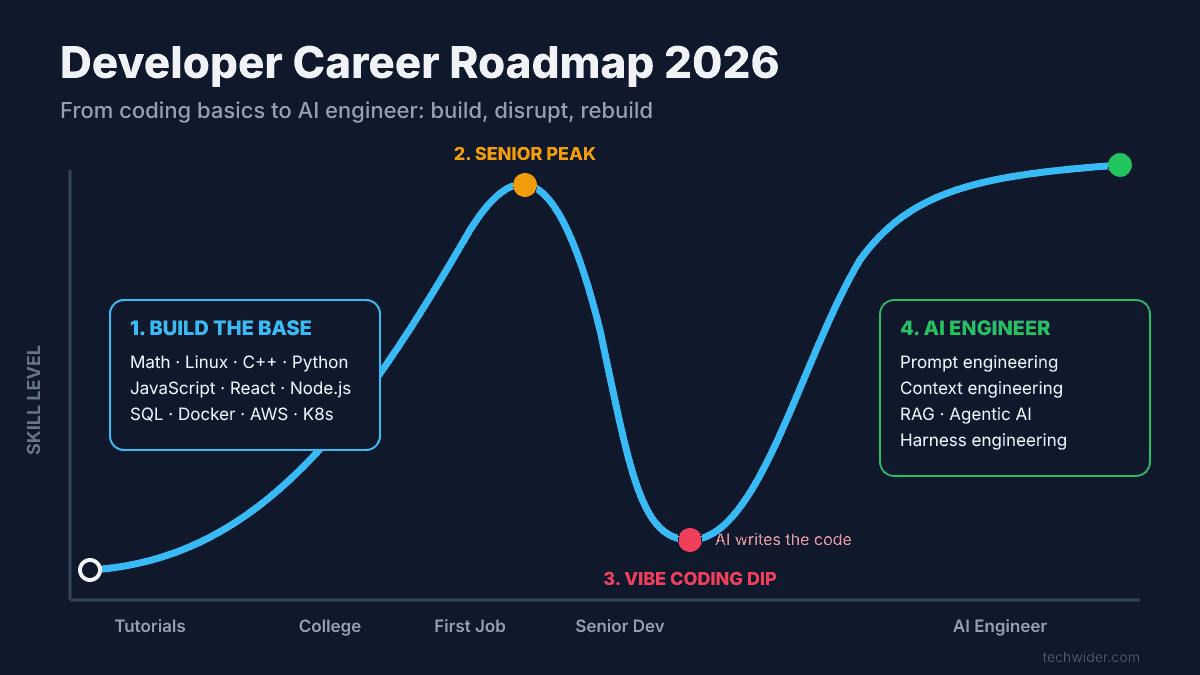
A developer career roadmap is a map of the skills you pick up as you move from beginner to expert. Picture a graph: skill level on the vertical axis, career stage on the horizontal one (tutorials, college, first job, senior developer and, now, AI engineer). For years that graph was a smooth upward curve. Today it looks more like a roller coaster, with a sharp drop when AI coding tools arrived and a steep climb for those who adapt. The idea was popularised by a widely shared infographic from tech creator Brij Kishore Pandey, and it matches what many engineers are living through.
Stage 1: Building the Foundation (Tutorials and College)
Every strong developer starts with fundamentals. Math builds the logical thinking behind algorithms. Linux teaches you how computers really work, from the file system to the terminal. Then come the first programming languages:
- C++ for memory, pointers and performance.
- Python for readable code, scripting, automation and data work.
- Java for object-oriented design and enterprise applications.
This stage is slow, and that is normal. You are not chasing frameworks yet. You are learning how to think like a programmer, and that never goes out of date.
Stage 2: The First Job (Web, Cloud and DevOps Skills)
Your first job is where the curve climbs fastest. Real projects force you to learn a full modern stack, usually in this order:
- Frontend: HTML, JavaScript, TypeScript, React and Next.js.
- Version control: Git, the daily tool of every team.
- Backend and databases: Node.js and PostgreSQL.
- DevOps and cloud: Docker for containers, AWS for cloud infrastructure and Kubernetes for running containers at scale.
Cloud and DevOps skills sit at the top of this climb for a reason. Knowing how to build, ship and scale an application end to end is what separates a junior developer from a dependable engineer.
Stage 3: The Senior Developer Peak
After years of practice, many senior developers reach a point where they think, “Finally, I am irreplaceable.” They know the stack, the systems and the business. Promotions follow. But that peak hides a risk: once you feel you have nothing left to learn, you stop learning. In a field that changes this fast, that is exactly when the ground shifts.
Stage 4: The Vibe Coding Era
Then AI coding tools arrived: ChatGPT, Claude, Gemini, GitHub Copilot, Cursor and OpenAI Codex. Suddenly anyone could describe an app in plain English and get working code back. This style of building, where you guide the AI by “vibe” instead of writing every line, became known as vibe coding.
For senior developers, this felt like a sharp drop. Skills that took years to build, such as writing boilerplate, remembering syntax or setting up a React project, could now be produced in seconds. The value did not disappear, but it moved. Writing code is no longer the scarce skill. Knowing what to build, how to check it and how to make AI work reliably is.
Stage 5: The Comeback – Becoming an AI Engineer
The good news is that the curve climbs again, and faster than before. The AI engineer roadmap builds on everything you already know. These are the key skills, in learning order:
- Prompt engineering: writing clear instructions, examples and constraints so AI models give accurate, consistent output.
- Context engineering: deciding what information, documents and history the model sees, because the right context matters more than clever wording.
- RAG (retrieval-augmented generation): connecting AI to your own data through search and vector databases, so answers are grounded in facts.
- Agentic RAG: letting the AI decide what to search, when to search again and how to combine results.
- Agentic AI: building AI agents that plan, call tools and APIs, and complete multi-step tasks on their own.
- Harness engineering: designing the system around the model (tools, permissions, memory, testing and guardrails) so agents are safe and reliable in production.
Notice how much of this rewards experience. A developer who understands APIs, databases, Docker, cloud and Kubernetes is perfectly placed to build and run AI agents in production.
How to Follow This Developer Career Roadmap in 2026
- Keep your fundamentals strong. AI writes code, but you still need to read, debug and review it.
- Use AI coding tools every day. Treat Copilot, Cursor or Claude as a pair programmer, not a threat.
- Build one RAG project. A chatbot over your own documents teaches embeddings, vector search and evaluation.
- Build one AI agent. Give it tools, run it on your cloud setup and learn where it fails.
- Focus on reliability. Testing, monitoring and guardrails are what companies pay for.
Frequently Asked Questions
Will AI replace software developers?
AI is replacing routine coding tasks, not developers who adapt. Demand is shifting toward engineers who can design systems, review AI output and build AI-powered products.
What is vibe coding?
Vibe coding means building software by describing what you want to an AI tool and refining its output, instead of writing every line yourself.
How long does it take to become an AI engineer?
An experienced developer can learn prompt engineering, RAG and agent basics in three to six months of steady practice. Mastery comes from shipping real projects.
Final Thoughts
The developer career roadmap is no longer a straight line. It is a cycle of building, peaking, being disrupted and climbing again. The engineers who win in 2026 are not the ones who knew the most frameworks. They are the ones who kept learning when AI changed the rules. Your past skills are not wasted. They are the base for your next climb.