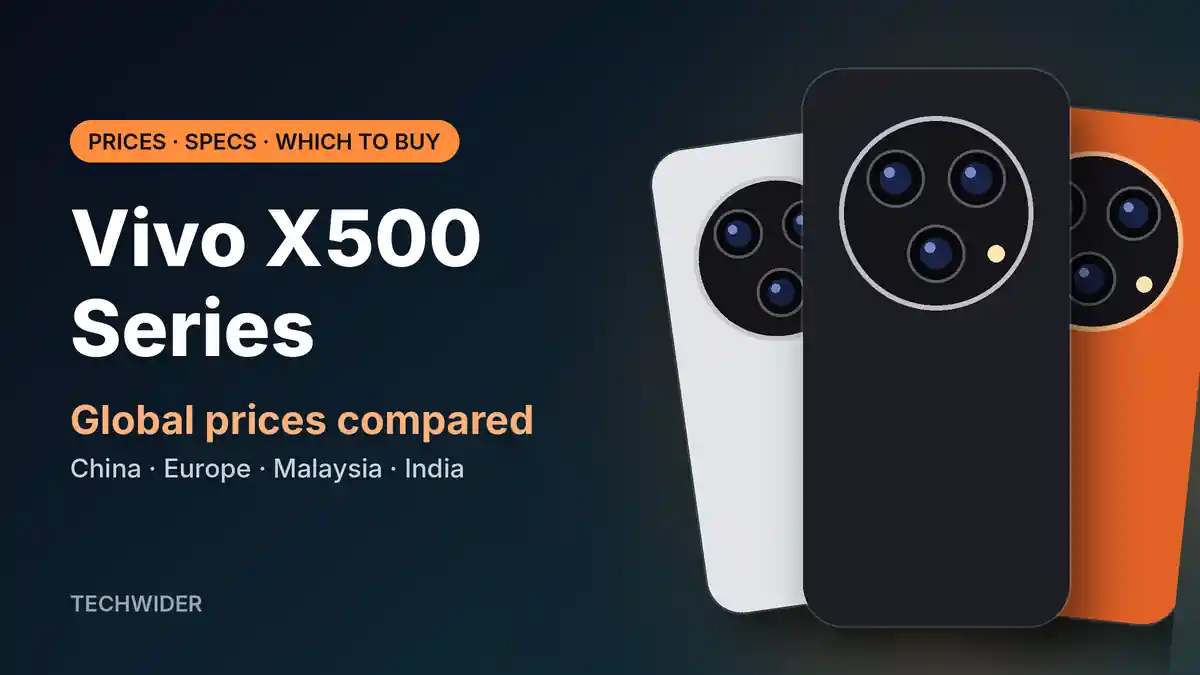
Vivo’s X500 series has now reached most of the markets it was planned for. The phones launched in China on 21 September, moved to Europe and Malaysia on 27 October, and arrived in India on 26 November. If you have been waiting to see what they cost where you live, the picture is finally complete, and it is not a cheap one.
There are three models: the X500, the X500 Pro and the X500 Pro Max. All three are built around cameras co-engineered with ZEISS, and the Pro Max is the one getting the attention, thanks to a 200MP periscope telephoto and support for a 400mm clip-on lens. Not every country gets all three, though, and the price gap between regions is wide.
Vivo X500 series prices around the world
| Region | X500 | X500 Pro | X500 Pro Max |
|---|---|---|---|
| China | CNY 5,499 | CNY 6,499 | CNY 6,999 |
| Europe (Germany) | Not sold | €1,399 | €1,599 |
| Malaysia | RM4,699 | RM5,699 (launch offer) | RM6,099 (launch offer) |
| India | ₹1,19,999 | ₹1,49,999 | ₹1,64,999 |
All prices above are for the 12GB RAM and 256GB storage version. In Europe the Pro Max also comes in 512GB for €1,799 and 1TB for €2,199. Malaysia’s early-bird prices sit below the official retail price of RM5,999 for the Pro and RM6,399 for the Pro Max, so expect those to rise once the offers end. In India, a Pro Max Photographer Kit with 512GB and the camera accessories costs ₹2,29,999.
The China prices convert to roughly $820, $970 and $1,045. Everywhere else, you pay a lot more for the same phone. The X500 Pro, for example, costs around 60% more in Germany than its converted Chinese price. European prices include VAT, which explains part of that gap, but not all of it.
Why everything costs more this year
Prices are up across the board, and not only at Vivo. Memory chip shortages have pushed flagship prices higher across the industry in 2026. In China, Vivo’s Photographer Kit edition rose from CNY 11,999 last year to CNY 13,999. Its sister brand iQOO launched the iQOO 16 with a starting price about 43% higher than the iQOO 15, without adding any extra base memory.
India shows the jump most clearly. The X300 launched there at ₹75,999 last year; the X500 starts at ₹1,19,999. That is ₹44,000 more for the entry model of the same series.
Vivo X500: the sensible one, if you can get it
The standard X500 runs MediaTek’s 3nm Dimensity 9600M with Vivo’s V3+ imaging chip, 12GB of RAM and a 6.59-inch 144Hz AMOLED screen. Its rear cameras are a 50MP Sony LYTIA 828 main sensor, a 50MP ultrawide and a 64MP Sony LYTIA 610 telephoto with a ZEISS APO lens at a 72mm-equivalent focal length.
That telephoto is the part that matters. A roughly 3x lens is what most people actually use for portraits, and the X500 also accepts Vivo’s 200mm Telephoto Extender for long-range shots at concerts or sports. Add a 7,500mAh battery, 90W wired and 40W wireless charging, and you have a phone that covers almost everything the Pro does. The problem is availability: it is sold in China, Malaysia and other parts of Southeast Asia, and India, but Europe skipped it entirely.
Vivo X500 Pro: the compact flagship
Strangely, the Pro is the smallest phone in the lineup, with a 6.36-inch 1.5K LTPO display. It moves to the 2nm Dimensity 9600 Pro and a 50MP LYT L910 main sensor that uses LOFIC technology to keep detail in very bright and very dark parts of the same scene. The telephoto is a 64MP periscope at 85mm.
The trade-off is battery life. The smaller body fits a 6,510mAh cell, the smallest in the range and nearly 1,000mAh less than the cheaper X500. This is the model for people who want top-tier cameras in a phone they can use with one hand, and in Europe it is the cheapest way into the series.
Vivo X500 Pro Max: a zoom camera that makes calls
The Pro Max keeps the Pro’s chip and main camera but swaps in a 200MP HP0 periscope telephoto at 85mm. With that much resolution you can crop deep into a zoomed shot and still keep usable detail. It is also the only model that works with the 400mm Telephoto Extender Gen 2 Ultra, which turns it into something close to a wildlife camera.
It gets the largest screen too, a 6.85-inch 2K LTPO panel with up to 4,500 nits of local peak brightness. Battery size depends on where you buy it: the Chinese version has an 8,000mAh cell, while the models sold in Europe, Malaysia and India use 7,800mAh.
Specs at a glance
| X500 | X500 Pro | X500 Pro Max | |
|---|---|---|---|
| Chip | Dimensity 9600M (3nm) | Dimensity 9600 Pro (2nm) | Dimensity 9600 Pro (2nm) |
| Display | 6.59-inch, 144Hz | 6.36-inch 1.5K LTPO, 144Hz | 6.85-inch 2K LTPO, 144Hz |
| Main camera | 50MP LYTIA 828 | 50MP LYT L910 | 50MP LYT L910 |
| Telephoto | 64MP, 72mm | 64MP, 85mm | 200MP, 85mm |
| Battery | 7,500mAh | 6,510mAh | 7,800mAh (8,000mAh in China) |
| Charging | 90W wired, 40W wireless | 90W wired, 40W wireless | 90W wired, 40W wireless |
| Protection | IP68, IP69 | IP68, IP69 | IP68, IP69 |
| Software | OriginOS 7, Android 17 | OriginOS 7, Android 17 | OriginOS 7, Android 17 |
Which one should you buy?
If you live in China, Malaysia or India, the standard X500 is the best value of the three. It has the second-largest battery, a real portrait telephoto and extender support, and it costs noticeably less than the Pro.
In Europe the choice is simpler, because only the Pro and Pro Max are on sale. Pick the Pro if size matters to you, and the Pro Max if you want the longest battery life and the best zoom. The extra €200 for the Pro Max buys a bigger battery, a bigger screen and the 200MP telephoto, which makes it the better deal for most buyers who were already prepared to spend €1,400.
And if you simply want a fast phone with a good screen, there is no shame in skipping this generation. Prices are high everywhere this year, and the X500 series earns its price only if you will actually use those cameras.